If you had told me during my senior year of high school that I’d be undergoing egg retrievals before I finished my first year of college, I probably would’ve laughed. Or cried. Or both.
The truth is, I’ve always had irregular and very heavy periods like miss-school, ruin-your-favorite-jeans kind of heavy. But I never really thought much of it. I figured it was just my “normal.” Stress, hormones, maybe a little bad luck. And since I wasn’t trying to get pregnant (or even thinking about it), fertility wasn’t exactly on my radar.
But by the grace of God my story took a different turn.
My dad is actually a reproductive endocrinologist (aka fertility doctor), so I grew up hearing about follicles, embryos, and IVF long before I understood what any of it meant. One day, kind of casually, he suggested we run some bloodwork to “just check in on things.” No pressure, no panic, just curiosity.
He tested two key hormones:
- FSH (follicle-stimulating hormone) – made by your pituitary gland to help eggs grow. If it’s too high, it might mean your body’s working overtime to grow eggs that aren’t really there.
- AMH (anti-Müllerian hormone) – made by the cells around your eggs. It gives a snapshot of your egg reserve.
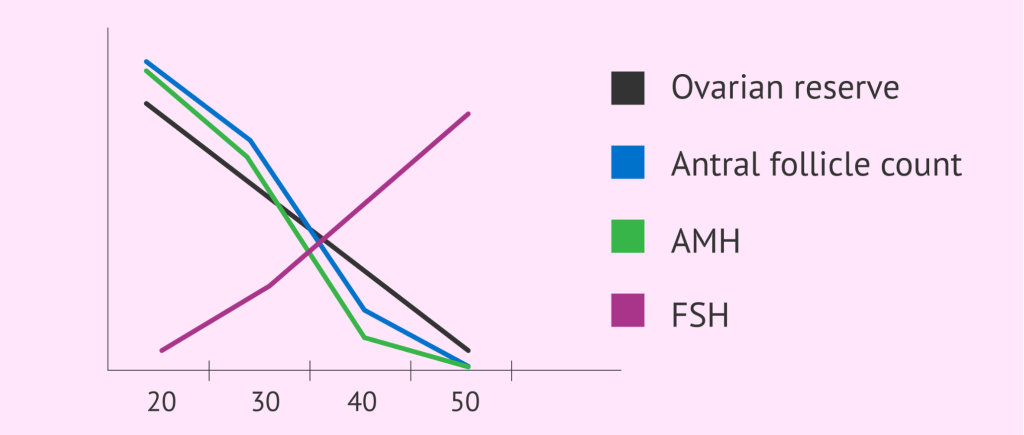
The results?
Low AMH.
Normal FSH
That was it. Quiet numbers on a lab report that said: something’s not right.
That’s when my dad sat me down and gently explained what it could mean: a low egg reserve. Possibly early signs of Premature Ovarian Insufficiency (POI).
I found this out the summer before college. I remember sitting in a Philadelphia hotel room the night before moving into my first college dorm, trying to process what it meant to be 19 and being told, “You might not be able to have biological kids later.” That’s a lot to carry when you’re still figuring out how to live on your own.
But in the middle of all that fear and uncertainty, there was also clarity.
Because I understood what those hormones meant. I had worked in the embryology lab. I had literally seen eggs under a microscope. And now, I was the patient.
That dual identity, student and specimen, future doctor and current fertility case, was surreal. But it helped me stay grounded. I decided to move forward with egg retrievals to preserve my fertility while I still had the chance.
And I’m so incredibly grateful. Grateful that I grew up around this field. Grateful that my dad caught it early. Grateful that I was empowered with information before I even knew I needed it.
That’s why I’m sharing all this. Because even though your story might not look like mine, you still deserve to know how your body works. You deserve providers who take you seriously. You deserve to ask questions and get real answers, whether you’re 19 or 39 or anywhere in between. So, if you’ve ever felt like your body was giving you signals you didn’t know how to read, I get it.
I’ve been there.


 Living with Premature Ovarian Insufficiency (POI)
Leave a comment